
As we navigate through and beyond menopause, we often focus on major health concerns such as heart health, dementia or bone density, but there are other (preventable) conditions that can really interfere with life – shingles being one of them. If you’ve ever had chickenpox, the herpes zoster virus never actually left your body; it’s simply been “sleeping” in your nerve tissues. Shingles occurs when that virus reactivates, often triggered by stress or the natural ageing of the immune system. Even if you have had the chicken pox vaccination (which most midlife women have not), there is still a chance, albeit very small, of getting mild shingles.
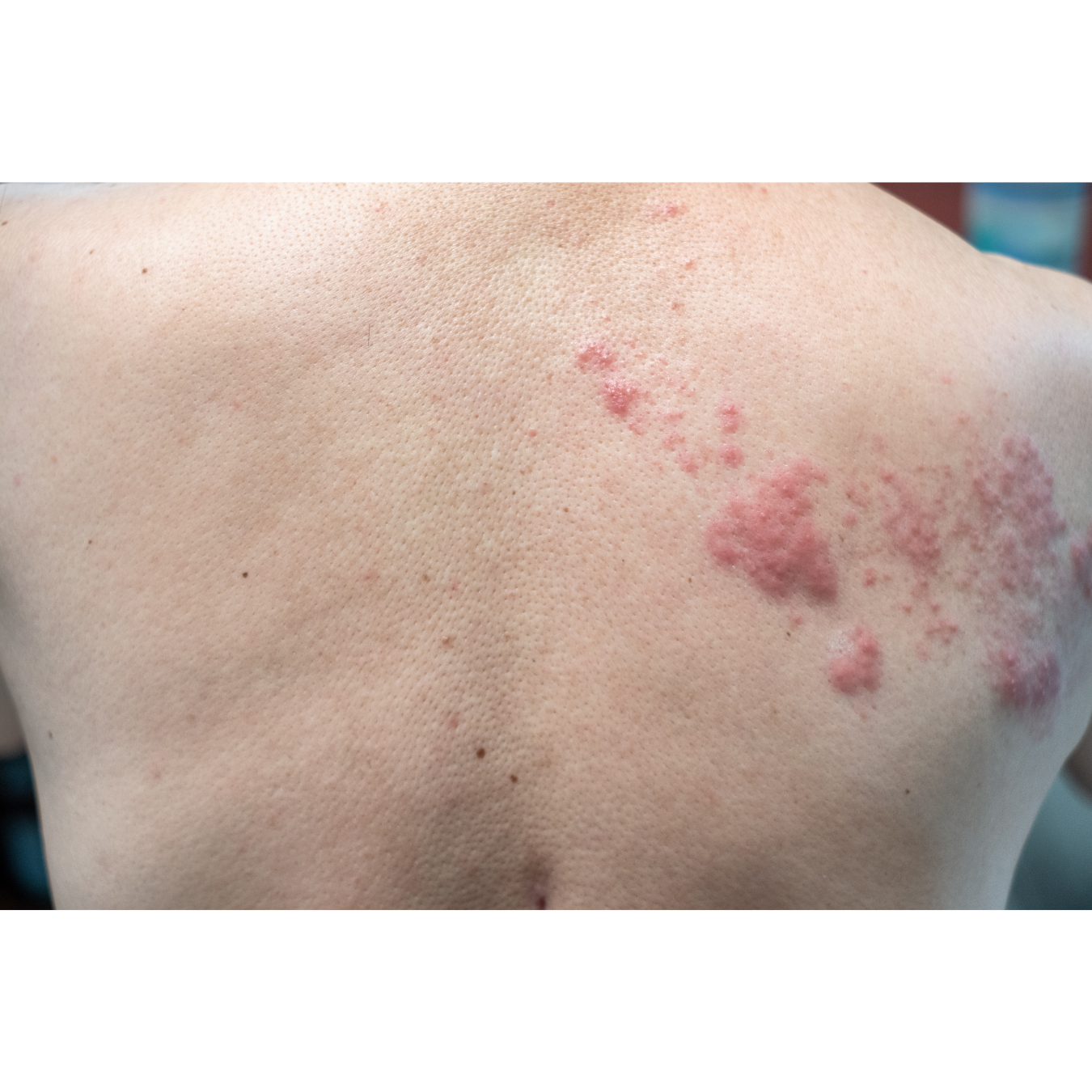
Shingles can occur anywhere on the body — most commonly the chest, back, abdomen, or less often the limbs or genitals. It typically affects one side only and follows a nerve distribution (a dermatome).
About shingles
Early symptoms (1-5 days before the rash appears)
-
Burning, tingling, stabbing, or electric-shock pain
-
Deep aching in a band-like area
-
Skin sensitivity (even clothing can hurt)
-
Itching or numbness
-
Mild fever, headache, or fatigue
The pain is usually localised to one side and does not cross the midline
Rash phase
-
Red patch that develops into clusters of small fluid-filled blisters
-
Blisters follow a stripe or band pattern
-
Rash stays on one side of the body
-
New blisters may appear for 3–5 days
-
Blisters crust over after 7–10 days
-
Heals over 2–4 weeks
- Pain continues through the rash phase and can be severe even if the rash looks mild.
Whilst shingles most commonly affects the torso, it can affect the face. The prodrome still occurs 1-3 days before the rash appears- pain, sensitivity, even fever and headache.The rash can occur across the forehead, cheek, scalp, nose, ear or mouth.
Eye involvement (urgent)
When shingles affects the ophthalmic branch of the trigeminal nerve (called Herpes zoster ophthalmicus) symptoms may include:
-
Red eye
-
Eye pain
-
Blurred vision
-
Sensitivity to light
-
Rash on the tip of the nose (a warning sign called Hutchinson’s sign)
If you suspect shingles is affecting your eye, go to an Emergency Department or see an ophthalmologist that day. Shingles in the eye can cause permanent scarring and vision loss.
Ear involvement
If shingles affects facial and ear nerves (known as Ramsay Hunt syndrome), symptoms may include painful rash in or around the ear; hearing loss; dizziness; facial weakness or paralysis on one side; and altered taste. This can resemble Bell’s palsy but includes pain and rash.
Can you “catch” shingles?
You cannot “catch” shingles from someone else, but if you have an active rash, you can pass the virus to others as chickenpox. The virus is contained in the fluid of the blisters and is spread through direct skin-to-skin contact or contaminated surfaces (like towels). You remain contagious from the moment the first blister appears until the very last one has completely crusted and scabbed over. To protect others—especially pregnant women, newborns, and the immunocompromised—keep the rash strictly covered with clothing or a bandage and maintain meticulous hand hygiene.
What to do if you suspect shingles
Time is of the essence. Shingles is treated with antiviral medication, which is most effective when started within 72 hours of the rash appearing. Keep the lesions covered and see your GP as soon as you can (that day). If shingles is involving the eye, this is a medical emergency – go to the ED and raise your concern about ophthalmic shingles as soon as you can.
Shingles vaccine
The current vaccine used in Australia is Shingrix, a non-live vaccine. It is incredibly effective, offering about 97% protection for those in their 50s and 60s. Even a decade later, protection remains high (around 80%).
It is a two-dose course (spaced 2–6 months apart). Common side effects include a sore arm at the injection site, fatigue, muscle aches, or a mild fever for 24–48 hours.
In Australia, the National Immunisation Program (NIP) provides the vaccine for free to everyone aged 65 years and over; First Nations people aged 50 years and over; immunocompromised adults (18+) with specific medical conditions.
If you are a healthy woman in your 50s, you can still access Shingrix privately via your GP or pharmacist. While costs vary, expect to pay approximately $280–$300 per dose (roughly $600 for the full course). Whilst this is a considerable financial investment, it may save a severely painful few weeks, prolonged pain from post-herpetic neuralgia or in some instances, damage to vision.